Sunday, April 30, 2017

mercedesbDESMA9

Week Four | MedTech & Art

The connections between medical technology and art is very relevant to modern day actions and procedures.

Orlan, a French artist, has what is considered to be a strange way of expressing art. She uses her body as her choice of medium through a series of cosmetic surgeries. With each surgery, she treated the procedures as an art performance. The surgeries were filmed for her viewers to see and they were treated as any other artistic display or performance. Orlan's artistic choices were really questioning beauty and what is considered beautiful in the most popular paintings. Instead of going through with these surgeries to make herself appear younger, as most do, she sought to question the idea of beauty. This is what many would define as extreme measures for the sake of artistic practices. This is a clear example of how medical technology has influenced art. In my opinion, this is very extreme of an artist to do for their art or to challenge norms. However, this is a very intriguing form of art to me that I had never known occurred.

Orlan Contoversial Artist Orlan The Reincarnation of SaintOrlan

Image result for orlan artist

There is a website called Driessens and Verstappen that has a section dedicated to Tickle Robots (shown below). These robots are designed for "automated skin caress." The nature of these gadgets can be related to medical technology because of the sensitivity of the robot and how it can be applied in medical ways. Inventions like these always amaze me because there seems to be hardly any limits on what technology can accomplish.

tickle at work


"Photo." Photo | ORLAN OFFICIAL WEBSITE / SITE OFFICIEL D'ORLAN. N.p., n.d. Web. 29 Apr. 2017. 

Orlan's Surgeries. N.p., n.d. Web. 27 April 2017.

Tickle Robots, Spear, Tickle, Tickle Salon, Driessens & Verstappen. N.p., n.d. Web. 27 Aprl 2017.  

Tickle, Robot, Driessens & Verstappen, 1996/2006. N.p., n.d. Web. 28 April 2017.     

"Orlan - Alchetron, The Free Social Encyclopedia." Alchetron.com. N.p., 18 Jan. 2014. Web. 28 April 2017.   
         

Sunday, April 23, 2017

mercedesbDESMA9

Week Three | Robotics & Art

Robotics and art have quite the influence on each other. While it may be difficult to envision how art has influenced robotics, this week's lecture has shed light on how it has.

While the influence of robotics on art is clear, it is not always met with optimism and positivity. In "The Work of Art in the Age of Digital Reproduction," by Douglas Davis, he highlights what some consider to be the negative outcomes of digital advancements influencing art. Digital technology has begun to blur the lines between reproduction and original. As discussed in his piece, Davis analyzes how digital resources have made it possible for photographs and artwork to be reworked and made completely different from the original. As with the image below, technology was capable of changing the image far beyond the original. While the alterations made by digital technology may not always be as drastic as the one below, it is important to see the possibilities with digital technology.

Image result for digitally altered photos

I had never before considered how art may have an influence over robotics and technology. However, this week's resources helped me understand this possibility. The San Francisco Robotics Society of America's website showcased the 2005 World Exposition in Japan based around The Robot Project. The website discusses how Japanese people's interest in robots greatly increased due to the way they are shown in animation. This is an example of how art has influenced technology.


Electric Circus, the collaboration between Fred Abels and Mirjam Langemeijer, is the perfect example of the influence art and robotics have on each other. These two combined puppets and electronics to create a one of a kind experience for their audience. By marrying art and technology, they were able to create animated characters that came to life with the help of robotics. Below is an example of one of their creations, Mono the Monkey. This character exists through the combination of the art of his appearance and the technology, as well as robotics, behind his movements.


Mono the Monkey (Electric Circus)

Robotics and art are two areas that many may not consider to have any overlap. However, this week's topic proved otherwise.


Young, Meghan. "Human-Cat Hybrids : Human-cat Hybrids." TrendHunter.com. TREND HUNTER Inc., 17 Sept. 2014. Web. 19 Apr. 2017.

San Francisco Robotics Society of America (SFRSA). N.p., n.d. Web. 20 Apr. 2017.

Davis, Douglas. "The Work of Art in the Age of Post-Mechanical Reproduction." Leonardo 28 (1995): 381-86. Web.

Electric Circus Dresseur Der Automaten. N.p., n.d. Web. 20 Apr. 2017.

Mono the Monkey, Electic Circus. N.p., n.d. Web. 20 Apr. 2017.

mercedesbDESMA9

Event One | Lecture with Linda Weintraub

Weintraub's lecture titled, "Eco Materialism and Contemporary Art," covered a wide range of artists and styles. The connection between artists and the subject matter of their work was a prominent theme in Weintraub's lecture. This theme also tied in to some of the main concepts in the course, such as the relationship between art and science. James Bridle's work is interesting discuss within the context of distance between artists and their work. Bridle's work, "The Drone's Eye View," is centered around photographing the sites of drone strikes, or as close to the sites as he could estimate. His work is particularly interesting because of how detached he seems to be from his projects. With the case of Bridle, the images he shared were not created by him but automatically composed by the technology used. This is one level of separation along with the fact that Bridle did not visit the sites that he was showcasing. Below are a few samples of the photographs he shared of drone strike locations. Bridle's work brings up one of the main questions embedded in the course of the relationship between art, science, and technology.


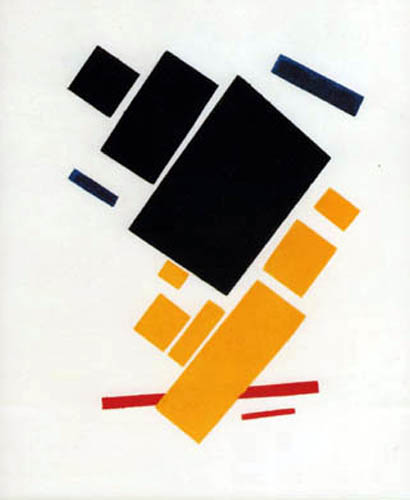
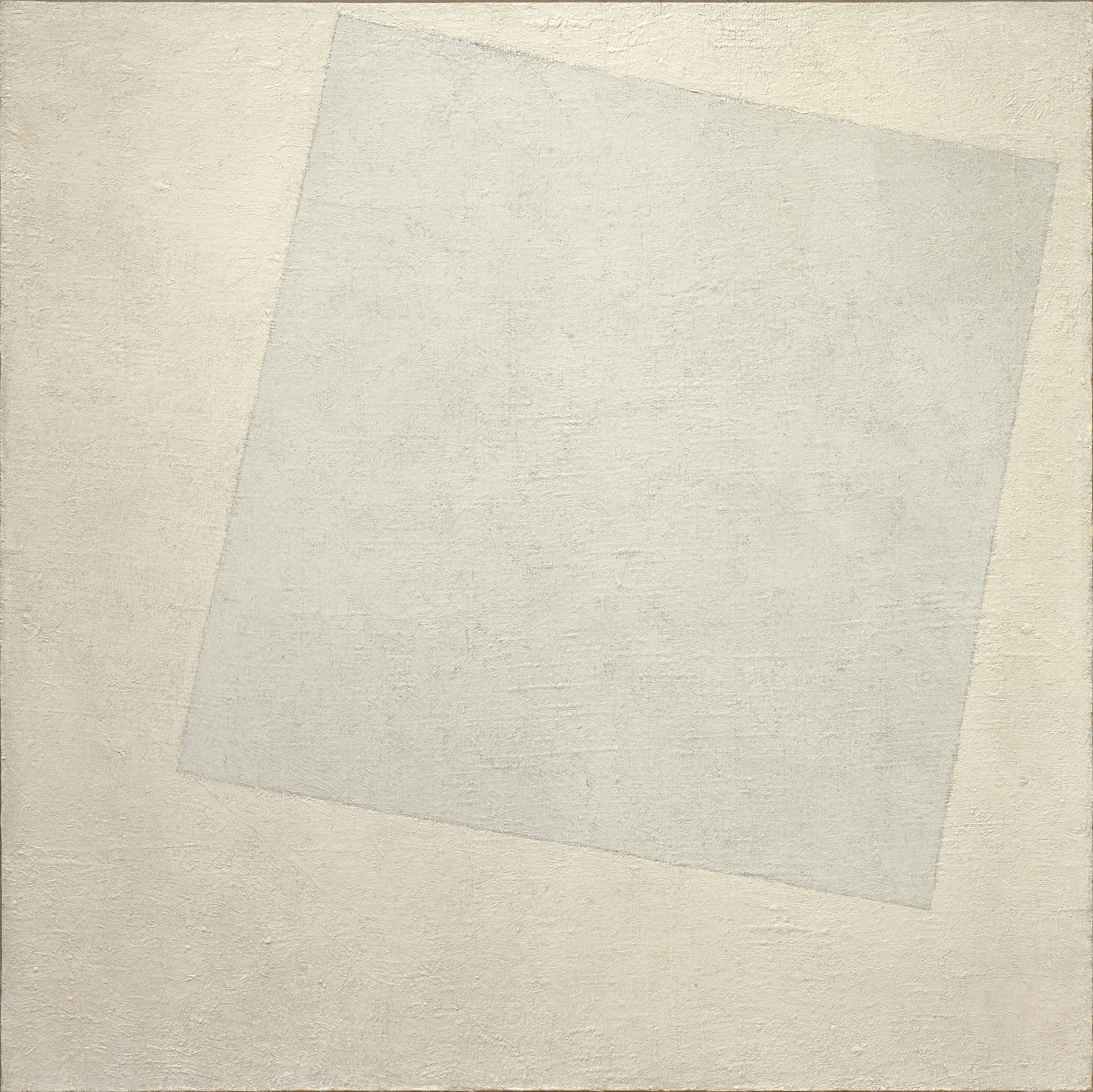
Another example of an artist that is questioned for his relationship with his art is Kazimir Malevich. Malevich's work was inspired by the views seen from the perspective of people in an airplane. Flight was a revolutionary action at this time. This altered perspective is known as suprematism. With Malevich's piece below, there is the sense of floating that humans had never had the opportunity to experience before flight became possible. With Malevich, there is a question of a disconnect because it is drastically different from our known reality. There is not a sense of texture, distance, or horizon, making it difficult for the viewers to connect to the work.

Kazimir Severinovich Malevich - Airplane in Flight
"Airplane in Flight"

                                  Kazimir Malevich. Suprematist Composition: White on White. 1918
"White on White

Linda Weintraub is very interactive with her environment and, therefore, her art. Her interaction with nature is what she calls a give and take relationship. For example, she receives sap from her trees and, in return, she scatters the ashes from the wood around the tree as a fertilizer. She also relies on certain resources, such as the wood she gathers for heat as well as the vegetables she gathers for food. Overall, her lecture was very insightful and encouraged me to consider how close an artist is to their work and how that may play a role in their views. I would definitely recommend this event because not only did it tie in to concepts of the class, it also was very interesting to learn more about Weintraub's lifestyle and how I can implement some elements into my own life.


Weintraub's animals


linda lecture.jpg


Kapplow, Heather. "The Fulfillment of Crafting a Home Like Art." Hyperallergic. Hyperallergic, 24 Feb. 2017. Web. 19 Apr. 2017.

"Kazimir Malevich. Suprematist Composition: White on White. 1918 | MoMA." The Museum of Modern Art. N.p., n.d. Web. 19 Apr. 2017.

"Booktwo.org." Dronestagram: The Drone’s-Eye View. N.p., n.d. Web. 19 Apr. 2017.

"ONLINE COURSE LOGIN." Course Login | Online Course Login. N.p., n.d. Web. 22 Apr. 2017.              

"Airplane in Flight." Art Printing in Tradition. N.p., n.d. Web. 23 Apr. 2017.                                   

Sunday, April 16, 2017

mercedesbDESMA9


Week Two | Math + Art

Math is more intertwined with art than I had ever previously imagined. Surprisingly, many of the masterpieces we stare at in admiration today would not have been possible without the marriage of art, math, and science.

A clear example of how mathematics influences art is illustrated in the vanishing point technique that hundreds of artists utilize in their work. This technique is shown in the picture above, showing how this adds depth and dimension to pieces of art. Creating a vanishing point is a very mathematically heavy process. It involves the manipulation of planes and using specific angles and lines. "Lesson 3: Vanishing Points and Looking at Art" was very useful in explaining vanishing points and how they are created in art. Aside from vanishing points, there are other ways in which mathematics is incorporated in art, such as in origami (see picture below). When creating polypolyhedras, such as the one below, it relies on mathematics to join the angles up to ninety degrees. There are more examples of mathematics present in the art of origami on Robert J. Lang's origami website, langorigami.com. Another artist, named Charles Csuri, creates much of his art using digital technology. The link below will direct you to a piece he created titled, "Talking Skulls." This video utilizes math with the use of technology to mimic what Csuri observed of this conversation between two people. Going along with the digital theme, Art + Com creates artwork that is configured "computationally," reigning in on the theme of art and its connection to math and science. Another example of mathematics being incorporated in art is seen with the work of M.C. Escher, who created art based off of mathematical themes.

http://www.csurivision.com/index.php/2012/02/talking-skulls/#more-466


This week's subject matter was very interesting and enlightening. The role of mathematics in art is astounding and they work well together to create the beautiful pieces of art we have today.

"Pendulum Casa V, 2015." ART+COM Studios Art En Project Department. N.p., n.d. Web. 16 Apr. 2017.

Paralle. Lesson 3: Vanishing Points and Looking at Art (n.d.): n. pag. Web.

Csuri, Charles. "Talking Skulls." CsuriVision. N.p., n.d. Web. 16 Apr. 2017.

"Vanishing Point Perspective Drawing Image." Image Vanishing Point Perspective Drawing Download. N.p., n.d. Web. 16 Apr. 2017.                         

"Polypolyhedra in Origami." Polypolyhedra in Origami | Robert J. Lang Origami. N.p., n.d. Web. 16 Apr. 2017.                         

Sunday, April 9, 2017

mercedesbDESMA9


Week One | Two Cultures

C.P. Snow's idea of two cultures, as presented in The Two Cultures and the Scientific Revolution, can easily be related to my major and field of study, anthropology. At UCLA, there is a physical divide between these cultures with the campus layout. There is North Campus, which encompasses the social sciences, arts, and humanities on one side and South Campus, including the physical and life sciences, on the other.  I, being a member of the North Campus community, understand very well the divide between this community and that of the physical and life sciences of South Campus.
While anthropology is considered part of the humanities and social sciences, there is still plenty of overlap with the life sciences. With the field of anthropology, there are elements of the life sciences in certain subfields. There are medical anthropologists whose goal it is to study diseases of certain areas and how these affected areas cope with these pathologies and how they are classified or thought of differently depending on the culture which may give further insight into their values and ideals. Something such as the picture displayed in the magazine picture below may have also been created by a medical or biological anthropologist.
Magazine Cover
http://science.sciencemag.org/content/279/5353/992.full

However, there is the idea of a rising "third culture" that is discussed not only in "Third Culture," by Kevin Kelly as well as "Toward a Third Culture: Being in Between." This third culture is described as being between the other two, helping to bridge the gap. The third culture has emerged due to technological advancements that have brought the two cultures together in some areas. In relation to anthropology, there are anthropologists utilizing technology to assist in their scientific studies. Brockman, in an interview with Duncan Graham-Rowe, expresses that the third culture comes from scientists bridging the gap through searching for deeper meanings that were traditionally sought after by literary intellectuals. This third culture is one way, in this field at least, where the divide between the two cultures is bridged. However, we still need to take into account the fact that there is a difference between science and technology, as stated by Stephen Wilson in "Myths and Confusions in Thinking about Art/Science/Technology." While there is still a clear divide between what Snow deemed to be the two cultures, we are moving towards more overlap than there has been in the past.

Image result for the third culture of john brockmanC.P. Snow and Two Cultures https://www.bing.com/images/search?view=detailV2&ccid=dJc4gmZ1&id=F195E81C05B75D922D4C924BB0A583B268D8A8B7&q=the+third+culture+of+john+brockman&simid=608043473620307924&selectedindex=8&mode=overlay&first=1&thid=OIP.dJc4gmZ1KE9WROhHhLSAowDsDs


Two Cultures http://blogs.reading.ac.uk/english-at-reading/files/2013/10/Interdisciplinary-Research-into-the-Humanities-and-Science.jpg

Vesna, Victoria. "Toward a Third Culture: Being in Between." Leonardo, Vol. 34, No. 2. (2001), pp. 121-125. Print

Wilson, Stephen. "Myths and Confusions in Thinking about Art/Science/Technology." Stephen Wilson, (2000). Print.

Snow, C.P. The Two Cultures and the Scientific Revolution. New York: Cambridge University Press, 1959. Print.

Kelly, Kevin. "Third Culture." sciencemag.org. American Association for the Advancement of Science. 13 Feb 1998. Web. 7 Apr 2017.

Graham-Rowe, Graham. "John Brockman: Matchmaking with Science and Art." 3 Feb 2011. Print.

mercedesbDESMA9

Extra Credit Event Two | Intersex: Beyond the Binary Today, I attended the symposium held in Royce Hall regarding intersex children and ...